"I read a book one day, and my whole life was changed." - opening line of The New Life, by Orhan Pamuk

Saturday, September 6, 2014

SHROUD, by John Banville

I recently discovered the very talented Irish writer John Banville. The first novel I read by him was Shroud. It's an extraordinarily well-written novel structured as two alternating narratives - the main one a first-person narrative of the protagonist, "Axel Vander" and the second a 3rd person telling of the story, mostly related to Vanders' emotionally disturbed would-be blackmailer. Anders is a complex character who has a considerable degree of self-knowledge. Earlier in life, in the midst of the chaos of pre-WWII Belgium,  he took the identity of a rich townsperson to hide his Jewish identity. Reinventing himself in London and then America, he became a famous literary critic by bluffing his way into high circles of academia. He confronts the deception that has been his life when he receives a veiled blackmail threat from an unknown woman. The story plays out in Turin, where he meets and becomes involved with the woman, Cass, who seems to be some sort of schizophrenic with unclear motives. The novel has some very lyrical and sometimes astonishing stylistic elements and is truly poetic. I later read Banville's earlier novels The Book of Evidence, and The Sea, which was long-listed for the Booker Prize, and found many thematic links and protagonists who shared  asocial characteristics. All-in-all, I found Shroud to be a more subtle and mature work and enjoyed it more.

For a review of the book from The Observer, click here: http://www.theguardian.com/books/2002/oct/05/fiction.johnbanville


HOW TO BE GOOD, by Nick Hornby

How to Be Good is a clever comedy by British writer Nick Hornby. It works well as social satire and also explores the ethical question of what it means to be a good person and do good. Hornby skillfully narrates the story from the perspective of the wife of a dysfunctional couple. Her husband, a cynical "rant-author" with a column in the newspaper, is callous, rude, satirical and self-centered. The wife is a hardworking, frustrated doctor. She is also not exactly a saint, as she is having an affair out of desperation. She decides to divorce as the novel opens. When the husband comes into contact with a kind of new-age healer-type figure (who seems not to fit our stereotype of that sort), he undergoes a personality change and becomes obsessed with "doing good" with schemes like giving away the family's "excessive" material perspectives and having the neighbors house homeless runaway teens. The wife finds that she is even less satisfied with the "new" husband and struggles to understand the concept of being good. It's a frequently funny story with deeper meaning.

For a review of the book from NY Times, click here: http://www.nytimes.com/books/01/07/01/reviews/010701.01queenat.html


Thursday, July 17, 2014

ME CHEETA, by James Lever

Me Cheeta, the Booker Prize-nominated novel based on the silly premise of an animal actor (Cheeta of Tarzan fame) writing a Hollywood memoir, turns out to be a great read - hilarious, frequently moving, inventive and just plain fun. The book ultimately becomes a kind of alternative Hollywood memoir that irreverently mocks not only our favorite Golden Age stars but also Hollywood's uniquely disturbing subculture and the love-hate relationship that humans have with their animal cousins. The narrative also has lots of soul and deep insights of the naive-yet-jaded narrator, the likable simian star of the Tarzan movies of the 1930s & 40s, who is often more "human" than the dysfunctional Hollywood stars into whose society he is thrust after being taken from the African jungle.


for a review of the book from The Guardian, click here: http://www.theguardian.com/books/2009/jun/06/me-cheeta-james-lever


Saturday, July 5, 2014

OPEN CITY, by Teju Cole

Open City is a strange, quiet interior monologue narrated by the protagonist, a young man who is 1/2 German and 1/2 Nigerian, who is a psychiatric intern in New York City. It reminds me a bit of the novel The Year of the Death of Ricardo Reis by Jose Saramago. Open City is mostly a series of seemingly disconnected observations and ruminations about daily life, in which a complex past sometimes intrudes. The city of NY is also a protagonist of sorts, that colors his observations and triggers his thoughts and memories. It's a strange, sometimes depressing, but strongly written book.

For a review of the book from The Guardian, click here: http://www.theguardian.com/books/2011/aug/17/open-city-teju-cole-review


Tuesday, June 10, 2014

THE ORPHAN MASTER'S SON, by Adam Johnson

Pulizer Prize-winning novel The Orphan Master's Son is an intense, harrowing, tragic yet heroic book (and yes, sometimes very funny) about someone who is both an everyman and  a "non-person" in Kim Jong Il's  North Korea. The protagonist, Jun Do  believes he does have a father (the Orphan Master of the title), yet he is treated as,  and adopts the near-zero social status of orphans. He is given the name of one of the national revolutionary "martyrs" (like all orphans), which identifies him as someone with no family ties. This status sets him up for a life of even more difficulty than the average North Korean. The story of the protagonist is told interestingly through three competing narratives - the main narrative, that of the interrogator and that of the State's official propaganda myth-makers. The narratives intertwine, intersect and contradict each other interestingly. Although the book is vivid in its details of the horrible effects of the living under the current (and past) North Korean regimes, the author is never gratuitous in depicting the unimaginable suffering in the society. The ending(s) are both expected and unexpected, tragic and heroic, depending on which narrative you read. Surely you will finish the book with admiration for the incredible strength of the North Korean people, and by extension, of oppressed people wherever they may live.

For a review of the book from The New Yorker, click here: http://www.newyorker.com/arts/critics/books/2012/02/06/120206crbo_books_mason


Sunday, June 1, 2014

DARKMANS, by Nicola Barker

Darkmans is an extraordinary novel that explores the intersection of history, present and identity. Set in a generic English town, the main characters are intertwined in interesting ways. Beede, the proper history scholar, activist and curmudgeon; Kane, Beede's slacker son with whom he has a strained relationship, and Dory, Beede's mentally unstable friend, married to his "crush". Things get weird when Dory seems to "channel" an evil 16th century jester. The book is long - over 800 pages, and I had actually started reading it some time ago but quit after about 50 pages. This time I resolved to stick it out, and after about 100 pages, things started to "fall into place", although it's a strange story indeed. The book is intriguing and entertaining, confusing, scary, funny and touching...quite a good read.

For a review of the book from The Guardian, click here: http://www.theguardian.com/books/2007/may/05/featuresreviews.guardianreview3


Tuesday, April 15, 2014

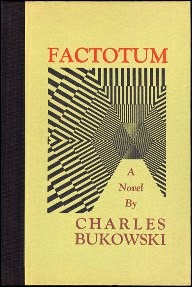
FACTOTUM, by Charles Bukowski

I'd heard of Charles Bukowski, of course, and had read some of  his poetry, but this was the first novel I read by him. It was suggested to me as a good introduction to his style. Set in the WWII and immediate post-war period, I couldn't help comparing it to Kerouac's On The Road, in that both books trace the random cross-country wanderings of unattached young men in the same historical period. There is a huge difference between the two books though, as all the youthful and romanticized enthusiasm of On The Road is totally lacking in Factotum, which is cynical and debased in tone. Factotum's protagonist, an aspiring writer, loner and total loser named Henry Chinaski, drifts across country and back, stumbling through one lousy job after another, usually drunk, engaging in hit-or-miss sexual adventures but always disdainful of the women involved. He's a loner by choice, ambition-less, except for a generalized desire to be a writer. Written in the first person in 1976, perhaps it's a thinly-disguised self-portrait?

For a review of the book by the NY Times, click  here: http://www.nytimes.com/books/99/12/26/specials/bukowski-factotum.html

Here's a good source on Bukowski, compiled by NY Times:  http://www.nytimes.com/books/99/12/26/specials/bukowski.html