"I read a book one day, and my whole life was changed." - opening line of The New Life, by Orhan Pamuk

Thursday, July 17, 2014

ME CHEETA, by James Lever

Me Cheeta, the Booker Prize-nominated novel based on the silly premise of an animal actor (Cheeta of Tarzan fame) writing a Hollywood memoir, turns out to be a great read - hilarious, frequently moving, inventive and just plain fun. The book ultimately becomes a kind of alternative Hollywood memoir that irreverently mocks not only our favorite Golden Age stars but also Hollywood's uniquely disturbing subculture and the love-hate relationship that humans have with their animal cousins. The narrative also has lots of soul and deep insights of the naive-yet-jaded narrator, the likable simian star of the Tarzan movies of the 1930s & 40s, who is often more "human" than the dysfunctional Hollywood stars into whose society he is thrust after being taken from the African jungle.


for a review of the book from The Guardian, click here: http://www.theguardian.com/books/2009/jun/06/me-cheeta-james-lever


Saturday, July 5, 2014

OPEN CITY, by Teju Cole

Open City is a strange, quiet interior monologue narrated by the protagonist, a young man who is 1/2 German and 1/2 Nigerian, who is a psychiatric intern in New York City. It reminds me a bit of the novel The Year of the Death of Ricardo Reis by Jose Saramago. Open City is mostly a series of seemingly disconnected observations and ruminations about daily life, in which a complex past sometimes intrudes. The city of NY is also a protagonist of sorts, that colors his observations and triggers his thoughts and memories. It's a strange, sometimes depressing, but strongly written book.

For a review of the book from The Guardian, click here: http://www.theguardian.com/books/2011/aug/17/open-city-teju-cole-review


Tuesday, June 10, 2014

THE ORPHAN MASTER'S SON, by Adam Johnson

Pulizer Prize-winning novel The Orphan Master's Son is an intense, harrowing, tragic yet heroic book (and yes, sometimes very funny) about someone who is both an everyman and  a "non-person" in Kim Jong Il's  North Korea. The protagonist, Jun Do  believes he does have a father (the Orphan Master of the title), yet he is treated as,  and adopts the near-zero social status of orphans. He is given the name of one of the national revolutionary "martyrs" (like all orphans), which identifies him as someone with no family ties. This status sets him up for a life of even more difficulty than the average North Korean. The story of the protagonist is told interestingly through three competing narratives - the main narrative, that of the interrogator and that of the State's official propaganda myth-makers. The narratives intertwine, intersect and contradict each other interestingly. Although the book is vivid in its details of the horrible effects of the living under the current (and past) North Korean regimes, the author is never gratuitous in depicting the unimaginable suffering in the society. The ending(s) are both expected and unexpected, tragic and heroic, depending on which narrative you read. Surely you will finish the book with admiration for the incredible strength of the North Korean people, and by extension, of oppressed people wherever they may live.

For a review of the book from The New Yorker, click here: http://www.newyorker.com/arts/critics/books/2012/02/06/120206crbo_books_mason


Sunday, June 1, 2014

DARKMANS, by Nicola Barker

Darkmans is an extraordinary novel that explores the intersection of history, present and identity. Set in a generic English town, the main characters are intertwined in interesting ways. Beede, the proper history scholar, activist and curmudgeon; Kane, Beede's slacker son with whom he has a strained relationship, and Dory, Beede's mentally unstable friend, married to his "crush". Things get weird when Dory seems to "channel" an evil 16th century jester. The book is long - over 800 pages, and I had actually started reading it some time ago but quit after about 50 pages. This time I resolved to stick it out, and after about 100 pages, things started to "fall into place", although it's a strange story indeed. The book is intriguing and entertaining, confusing, scary, funny and touching...quite a good read.

For a review of the book from The Guardian, click here: http://www.theguardian.com/books/2007/may/05/featuresreviews.guardianreview3


Tuesday, April 15, 2014

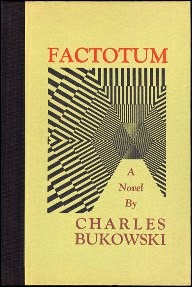
FACTOTUM, by Charles Bukowski

I'd heard of Charles Bukowski, of course, and had read some of  his poetry, but this was the first novel I read by him. It was suggested to me as a good introduction to his style. Set in the WWII and immediate post-war period, I couldn't help comparing it to Kerouac's On The Road, in that both books trace the random cross-country wanderings of unattached young men in the same historical period. There is a huge difference between the two books though, as all the youthful and romanticized enthusiasm of On The Road is totally lacking in Factotum, which is cynical and debased in tone. Factotum's protagonist, an aspiring writer, loner and total loser named Henry Chinaski, drifts across country and back, stumbling through one lousy job after another, usually drunk, engaging in hit-or-miss sexual adventures but always disdainful of the women involved. He's a loner by choice, ambition-less, except for a generalized desire to be a writer. Written in the first person in 1976, perhaps it's a thinly-disguised self-portrait?

For a review of the book by the NY Times, click  here: http://www.nytimes.com/books/99/12/26/specials/bukowski-factotum.html

Here's a good source on Bukowski, compiled by NY Times:  http://www.nytimes.com/books/99/12/26/specials/bukowski.html


THE GOLDEN GIZMO, by Jim Thompson

I stumbled upon this book while looking for a different title,The Alcoholic by the same author, pulp writer Jim Thompson. Golden Gizmo traces the meanderings of a con-man character by the name of Tod(dy) Kent, itinerant gold buyer and loser. Written in 1954, the book has an entertaining ambiance and reads somewhat like a detective novel of the period. In an alternative universe inhabited by a talking dog and a chinless man, Kent unwittingly uncovers an elaborate neo-Nazi plot involving international gold smuggling. Sounds far-fetched but it actually works, in a way. Worth a read if only for the bizarre story line and characters.

For a review of the book from Broad Street Review, click here: http://www.broadstreetreview.com/books-movies/Jim_Thompsons_Golden_Gizmo


Wednesday, March 26, 2014

ALL THAT FOLLOWS, by Jim Crace

All That Follows is a very engaging book by the gifted British writer Jim Crace (2010). It's the second book by him that I have read, the first being the very different The Gift of Stones set in the cusp between the stone and bronze age. In All That Follows, the protagonist  named Lennie is a somewhat self-absorbed and passive Jazz musician who finds himself, on his 50th birthday, embroiled in some unexpected intrigue involving an old acquaintance from his "radical days", and that man's estranged 17-year-old daughter, Lucy. The other main character is Lennie's wife, strong-willed with a streak of wildness that is usually under raps, due to her mundane schoolteacher job and the grief caused by her teenage daughter's running away. The trigger event in the plot centers around a hostage-taking incident involving Lennie's "friend" Max, and complications ensuing from an aborted plan to mitigate the situation. Interestingly, the story is mainly set in London in the late 2020's but also flashes back to 1980s Texas, when Lenny met Max and his girlfriend, Nadia, whom he had a crush on at the time. It's a well-written book with an unpredictable plot and lots of good characterization, not to mention witty satire and humor.

For a review of the book from       click here: http://www.theguardian.com/books/2010/apr/24/all-that-follows-jim-crace